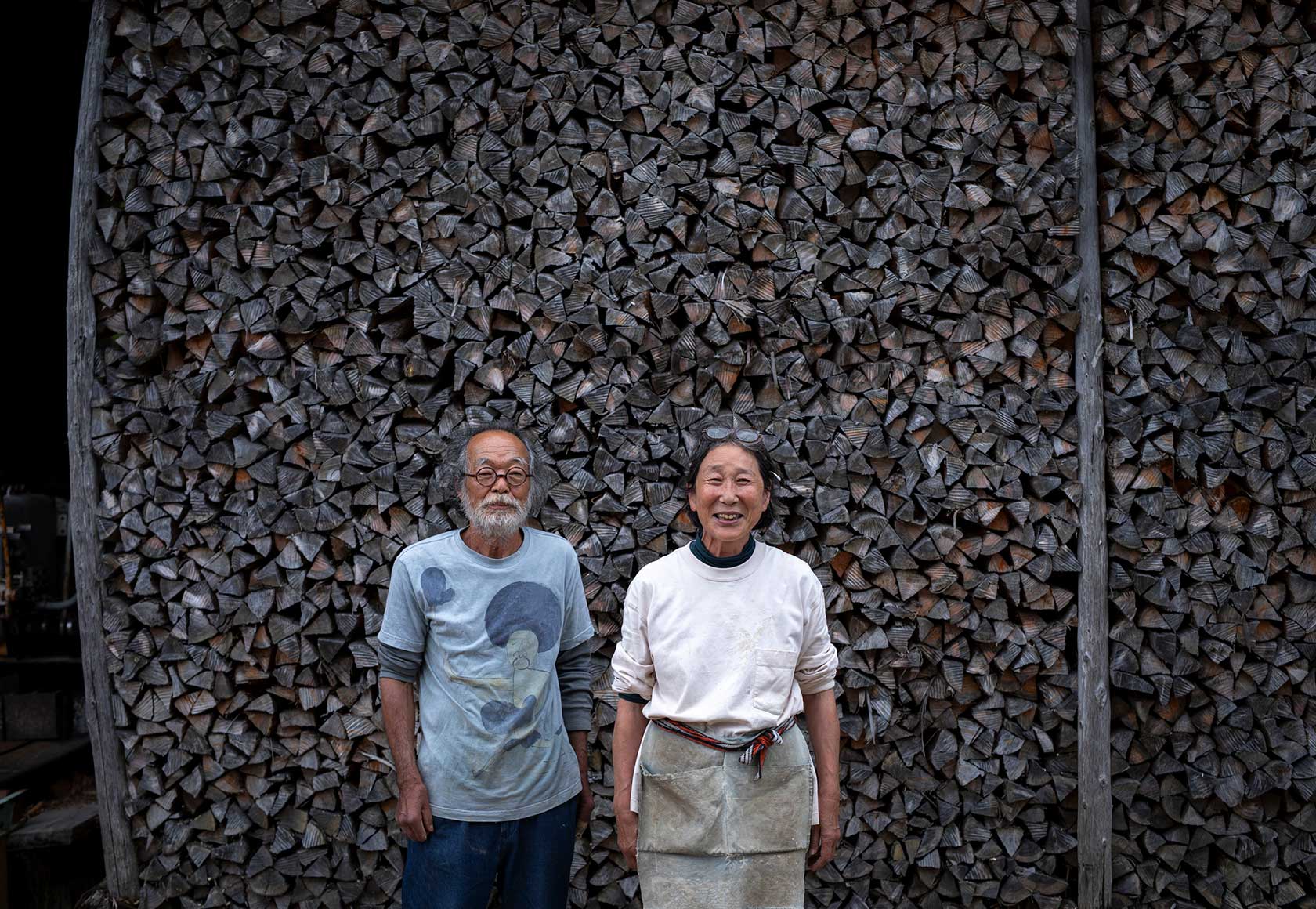
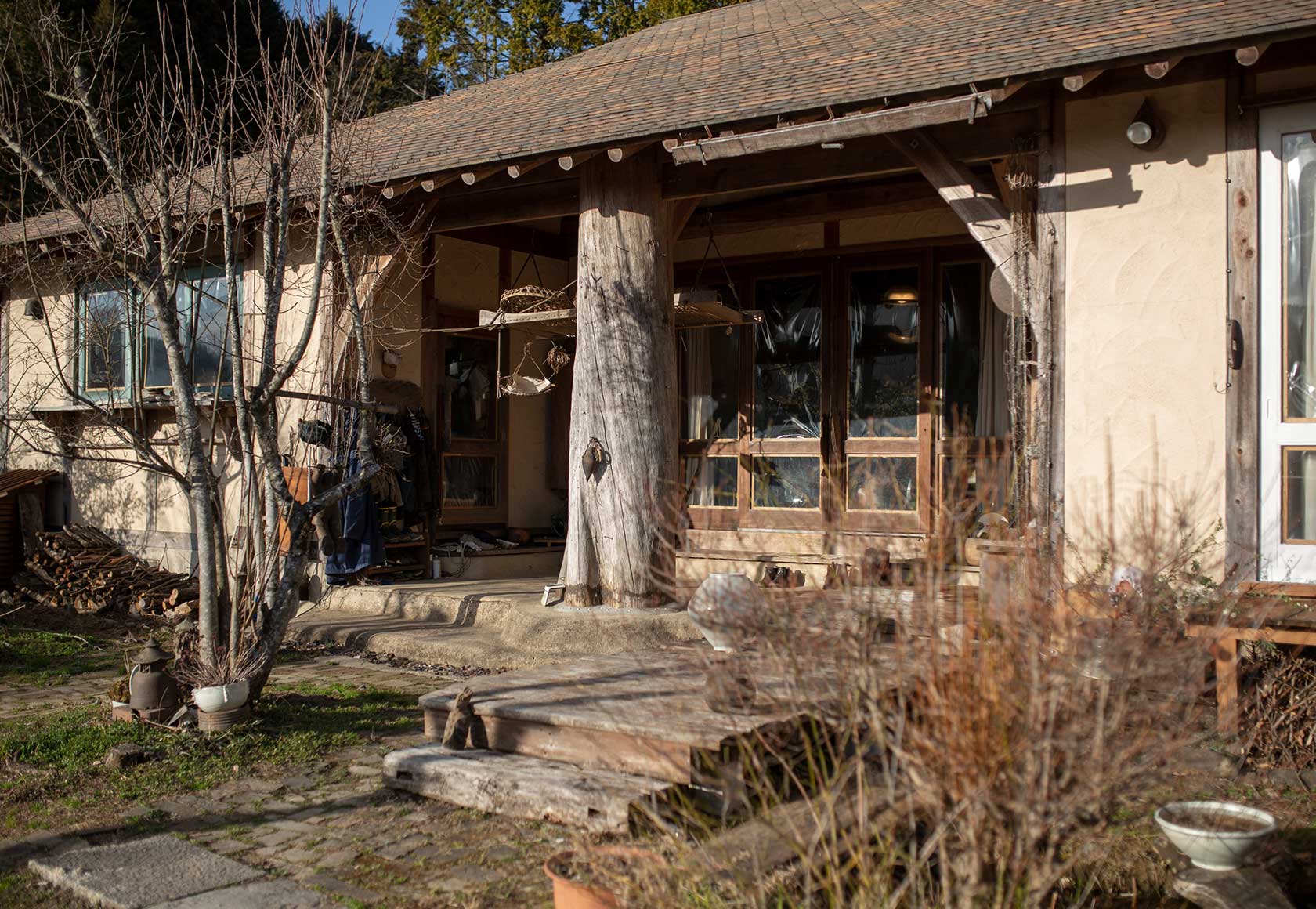
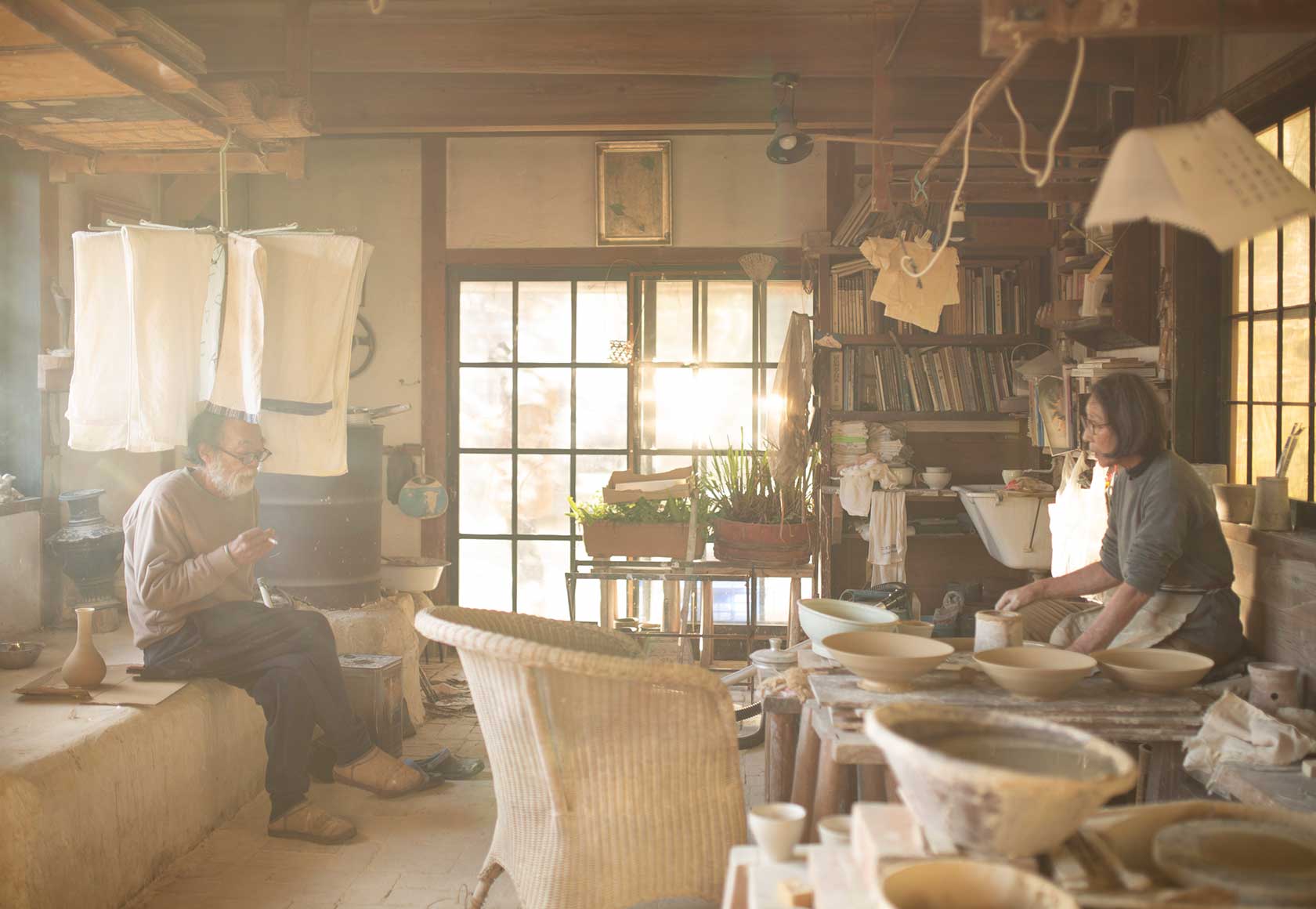
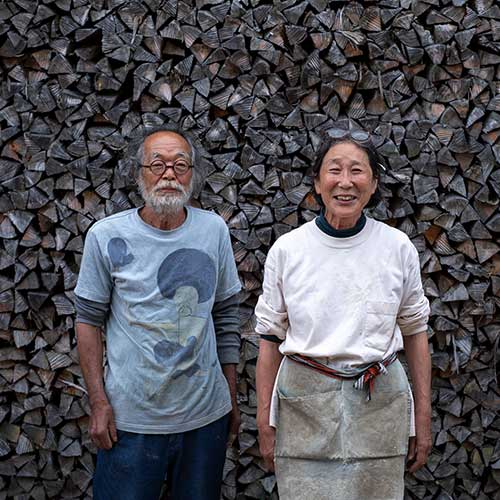
In the northeastern reaches of Wakayama Prefecture, at the foot of Mount Kōya, live Morioka Shigeyoshi and Morioka Yuriko—known affectionately as Shige and Yuri.Their home sits about 500 meters above sea level, on a hillside once cleared for pasture. Their property includes their residence, individual studios, kiln sites, a wood-splitting area, and vegetable gardens, where they both live and work.
“We built everything ourselves,” Shige says lightly, as though it were the most ordinary thing. Their home features a massive 300-year-old red pine tree prominently positioned at the eaves.Each structure is so well-built that it’s hard to believe they were self-built. Inside the two-story wooden house with exposed beams and pillars, a large table stands in the center, and just nearby, a cat basks in the sunlight atop a grand piano. The home exudes a spacious and abundant sense of daily life.
“Would you like to see the big kiln?” Shige asks.
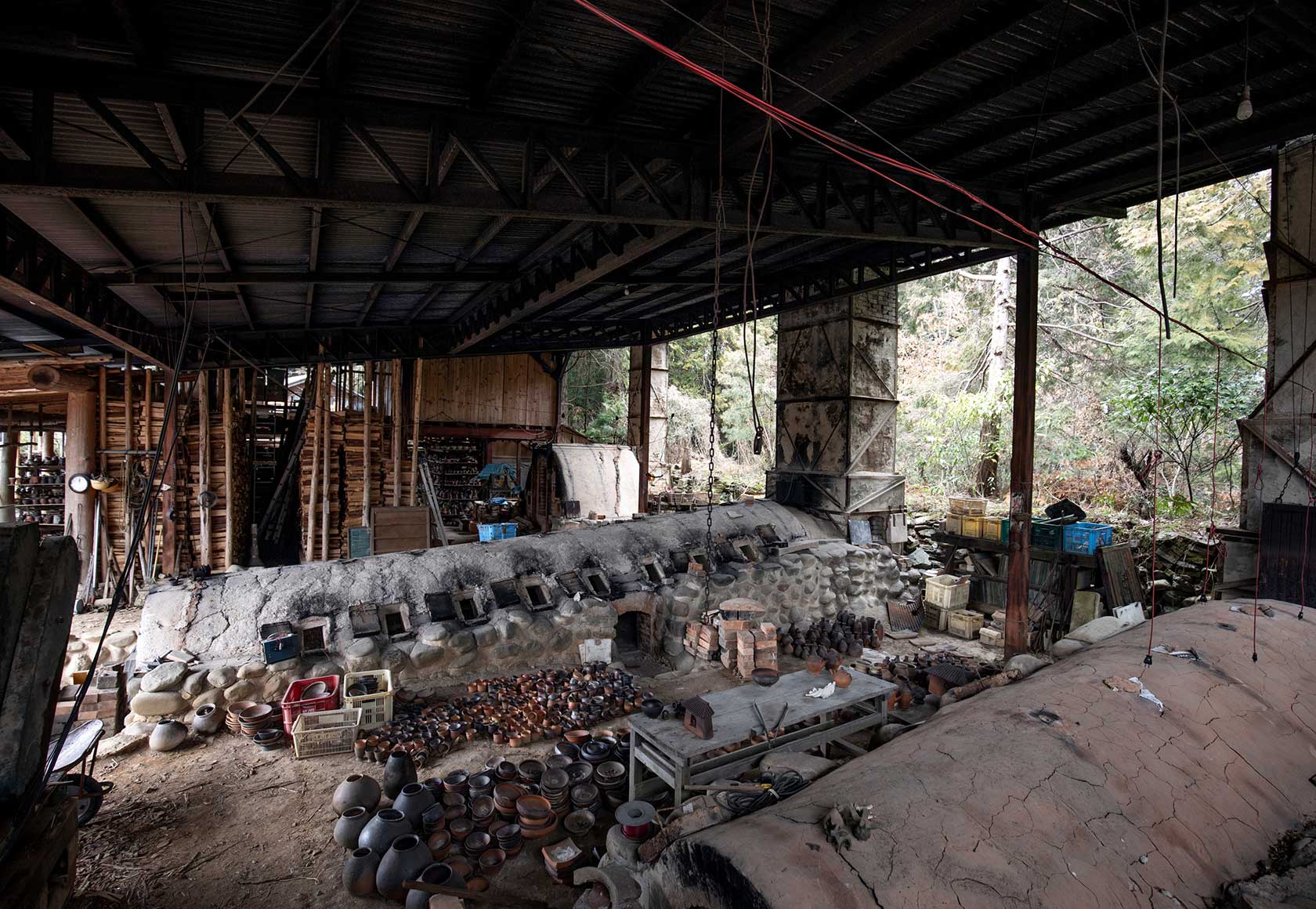
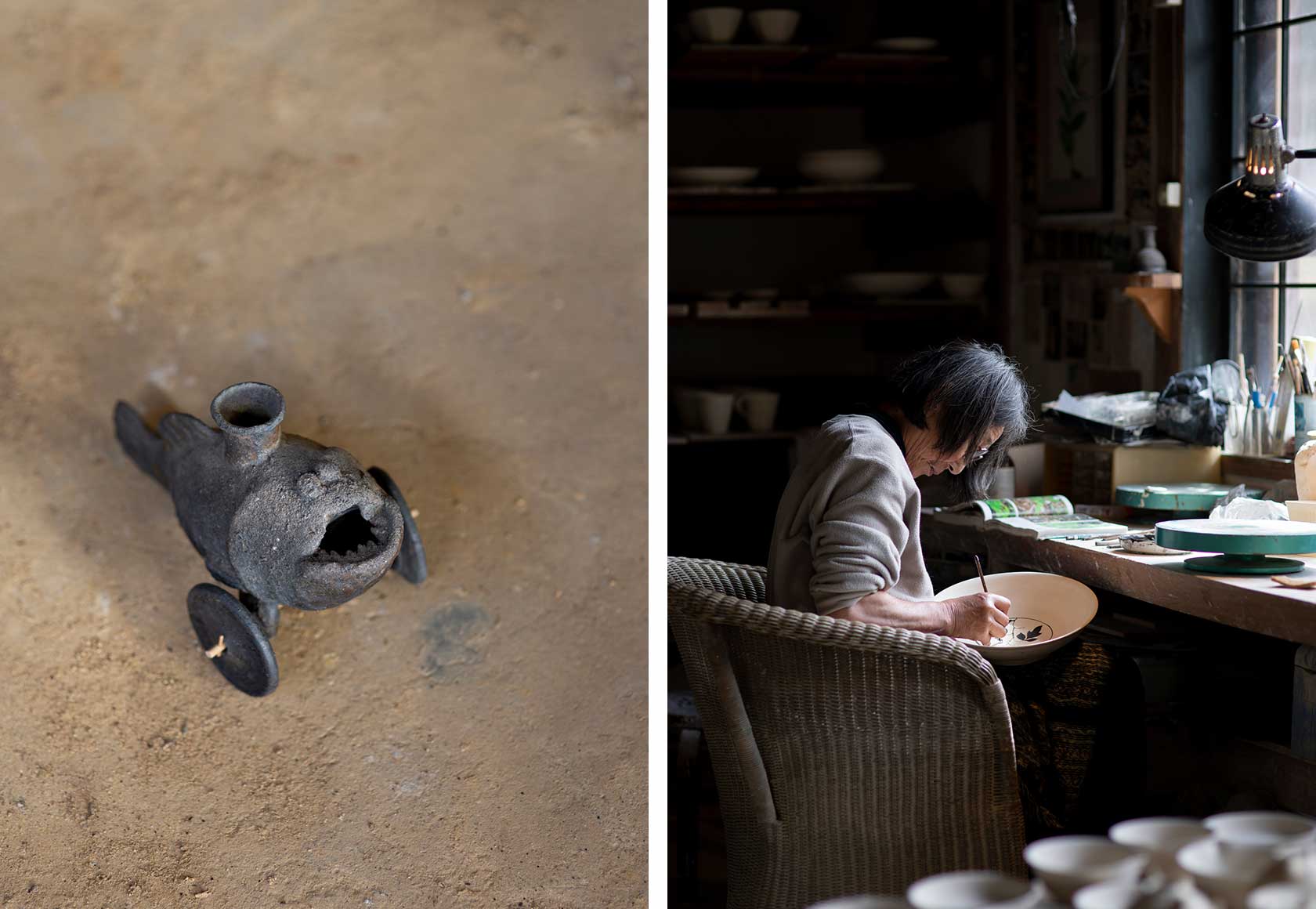
Passing through the wood-splitting area where logs are stacked high like great walls of timber, we come upon a huge kiln that seems to be about ten meters long. Its width is generous, with a row of fireboxes lining both sides, it is immense for a single potter.Twice a year, Shige fires this kiln with nanban yakishime, high-fired, unglazed stoneware he has devoted decades to making.
“It takes ten days to fire the kiln. The anagama has just one chamber, and between the large and small pieces, we fire around 4,000 to 5,000 items. Someone who helped count before said they got a headache counting to 5,000...” he laughs. “Each firing uses about thirty tons of wood.”
Next to it stands another anagama for glazed works, and beyond that, to the left, rises Yuri’s arched kiln for white porcelain. Though it looks small beside the large kiln, it can fire about two-fifths of the volume of the big kiln, so it’s also quite large. The whole scene resembles a ceramic factory.
“This kiln is actually smaller than the one before,” Shige says. “We rebuilt it about twenty years ago, as a kind of preparation for old age. The previous one could fire nearly ten thousand pieces at once.”
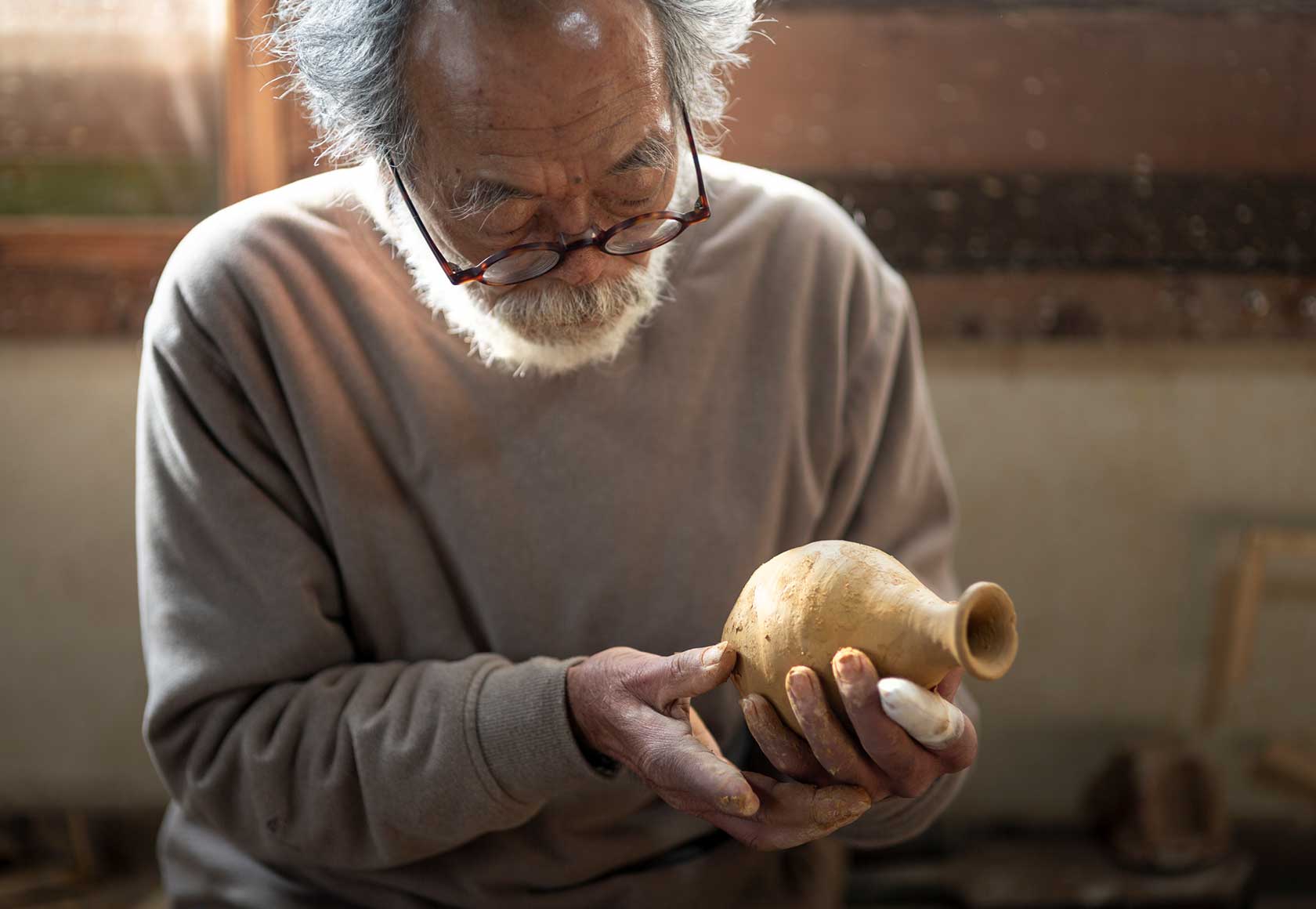
One wonders how much heat and strength they have invested into their pottery over the years. Of course, neither of them fires the kilns alone. For forty years now, they have lived and worked here side by side, the shelves surrounding the kiln filled with the traces of that journey: yakishime, glazed works, and the luminous white porcelain.
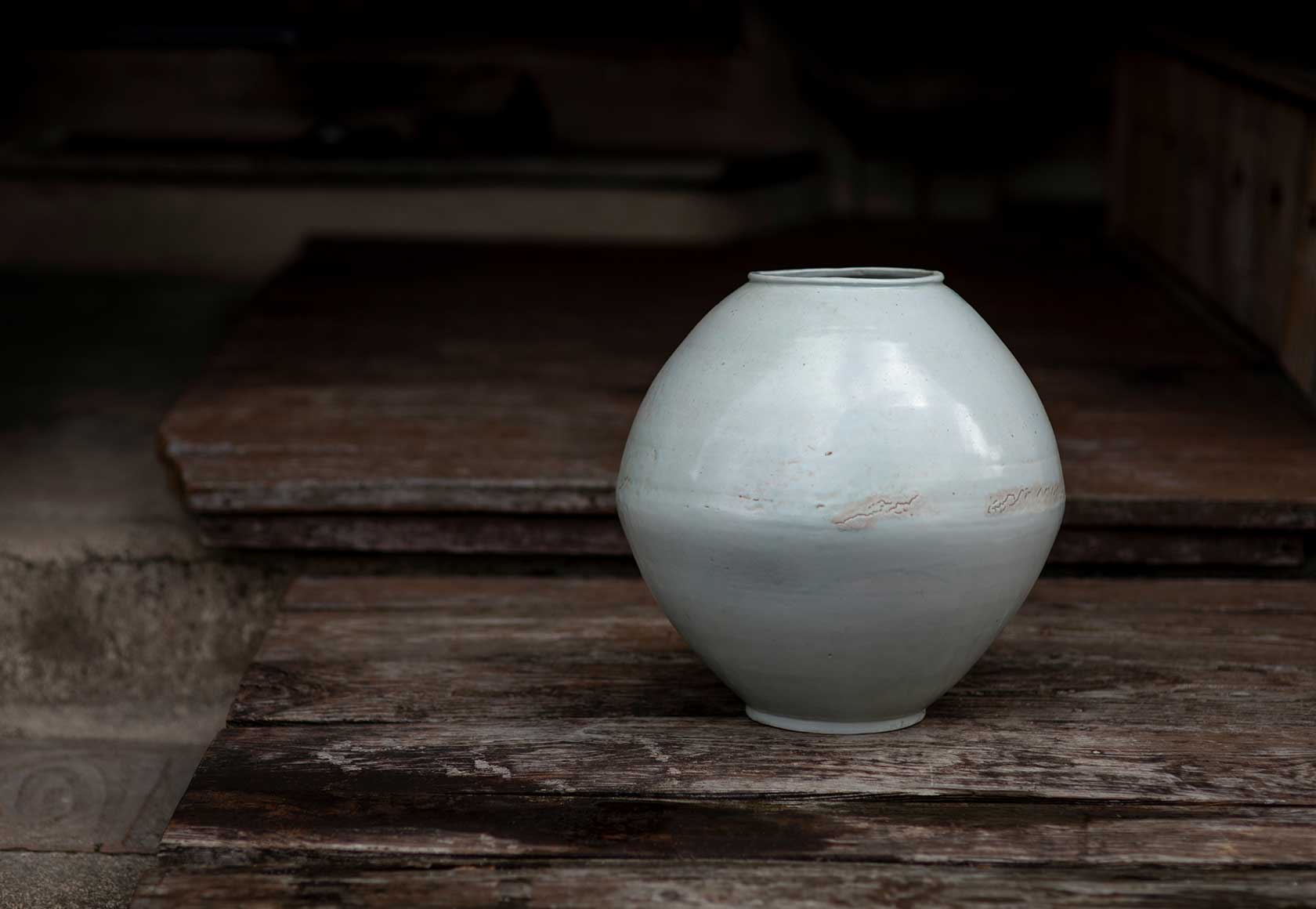
Born in Nara Prefecture in 1948. In 1971, he encountered nanban yakishime (Southeast Asian-style unglazed pottery on Tanegashima Island. In 1973, he established his kiln in Amano, Wakayama Prefecture. In 1981, he held a solo exhibition in New York, where one of his large jars was acquired for the Museum of Modern Art’s permanent collection. In 2008, he climbed the Nepal Himalayas. In 2010 he built a kiln in Ishigaki Island, Okinawa. Shigeyoshi has been producing work continuously for fifty years since his first kiln firing in Amano. He has held numerous exhibitions both in Japan and internationally.
Born in Iwate Prefecture in 1955. In 1978, she became a mountain hut keeper at Mount Tsurugi in the Tateyama Mountain Range. In 1980, she apprenticed under a yakishime (unglazed pottery) ceramic artist. In 1982, she began working with white porcelain in Amano, Wakayama Prefecture. She has climbed the Chinese Himalayas and held numerous exhibitions worldwide, including in Bangkok (1999), Korea (2009), New York (2018), Hangzhou (2021), and Shanghai (2023).